
The Database Has a Memory: When DOJ Redactions Break the Law
The Epstein Files

Update (December 23, 2025): New document-handling failures identified
I guess it wouldn’t surprise anyone to learn that the DOJ didn’t just leave metadata* intact in the Epstein release. That would have required some level of competence. No, in several cases they didn’t even bother to flatten* the files.
So while the public-facing version showed thick official-looking black bars, the actual PDFs released on justice.gov still contained the underlying text. Not hidden. Not encrypted. Just… sitting there. Selectable. Readable. Oops.
Silly DOJ. TRIX is for kids, but apparently so is basic document redaction.
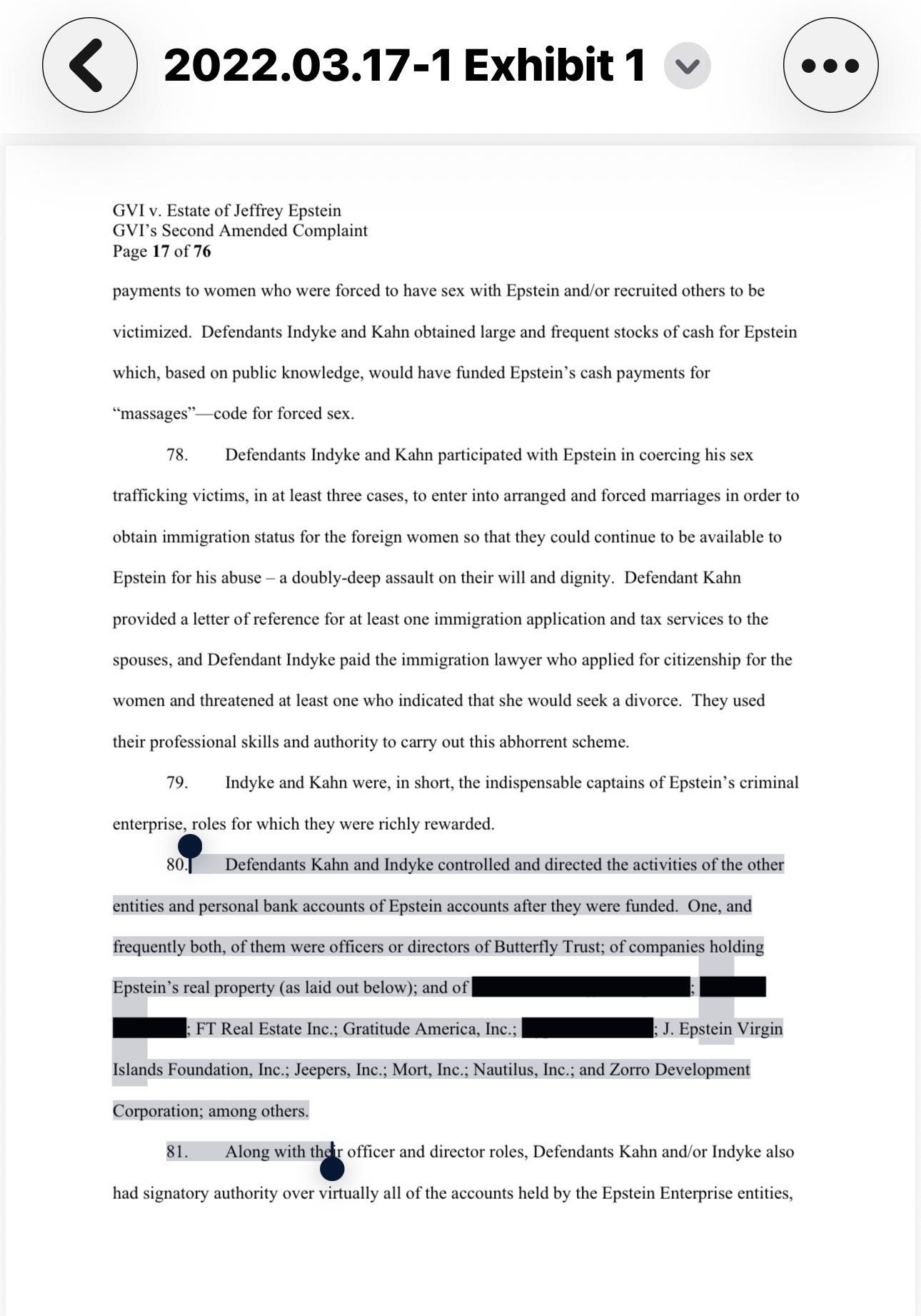
Which is how the same document can exist in two realities at once:
Version one: the screenshot I provided above, which flattens the document. Redactions burned in. This is what DOJ wanted people to see.
Version two: the original DOJ PDF (not shown here). Not flattened. Text layer intact. Which is how the following passage appears verbatim in the DOJ’s own release:
“Defendants Kahn and Indyke controlled and directed the activities of the other entities and personal bank accounts of Epstein accounts after they were funded. One, and frequently both, of them were officers or directors of Butterfly Trust; of companies holding Epstein’s real property (as laid out below); and of Financial Strategy Group, Ltd.; Financial Trust, Inc.; FT Real Estate Inc.; Gratitude America, Inc.; Hyperion Air, Inc.; J. Epstein Virgin Islands Foundation, Inc.; Jeepers, Inc.; Mort, Inc.; Nautilus, Inc.; and Zorro Development Corporation; among others.”
This is not victim information. This is not sensitive survivor testimony. This is a roadmap of financial control, corporate officers, trusts, asset-holding entities, and signatory authority.
So when DOJ claims the redactions were about protecting victims, forgive me if I laugh into my coffee. What they were clumsy about exposing wasn’t trauma. It was money, governance, and institutions.
And when they realized they’d screwed it up? Cue the scrambling. Files pulled. PDFs swapped. Redactions tightened after the public already had access.
This wasn’t transparency gone wrong; this was a botched release by an agency that forgot Redaction 101.

Today, December 19, 2025, the Department of Justice released another batch of Epstein-related files—on the final day allowed by federal law. Many of the documents were already public, but this release arrived swathed in heavier black ink. Names vanished, lines severed, context surgically removed. The official posture was one of incremental disclosure, with the familiar promise that more, always more, would follow over the coming weeks. Predictably, public outrage laser-focused on the redactions themselves: the hidden names, the unspoken connections, the silent spaces where there should be stories.
But here’s what matters more than what’s hidden: the DOJ violated federal law to hide it.
The Law They Broke
On November 19, 2025, President Trump signed the Epstein Files Transparency Act into law with near-unanimous bipartisan support. The statute is unambiguous. Section 2(a) states that within 30 days — by today — the Attorney General must
“make publicly available in a searchable and downloadable format ALL unclassified records, documents, communications, and investigative materials” related to Epstein.
The law goes further. It explicitly prohibits withholding or redacting records
“on the basis of embarrassment, reputational harm, or political sensitivity, including to any government official, public figure, or foreign dignitary.”
Today, the DOJ acknowledged it would not comply. Deputy Attorney General Todd Blanche announced the release of “several hundred thousand” pages, with “several hundred thousand more” to follow over the next couple of weeks. Legal scholars and lawmakers from both parties immediately identified this as what it is: a violation of federal law.
The statute contains no enforcement mechanism. No penalty for noncompliance. The DOJ is betting that this absence of teeth means the law can be ignored with impunity. Congress is examining legal options, including contempt proceedings and private lawsuits. But as of this writing, the violation stands unchallenged.
So while the world argues about what’s been redacted, the more fundamental story is this: they broke federal law to keep it redacted.
What the System Forgot
I didn’t start with outrage about black boxes. I started with curiosity about a system.
I went to the DOJ’s own public search portal, a clunky, utilitarian interface — and did the simplest thing imaginable. I typed a name. What came back wasn’t a bombshell; it was a bureaucratic stutter. A system betraying its own keepers.
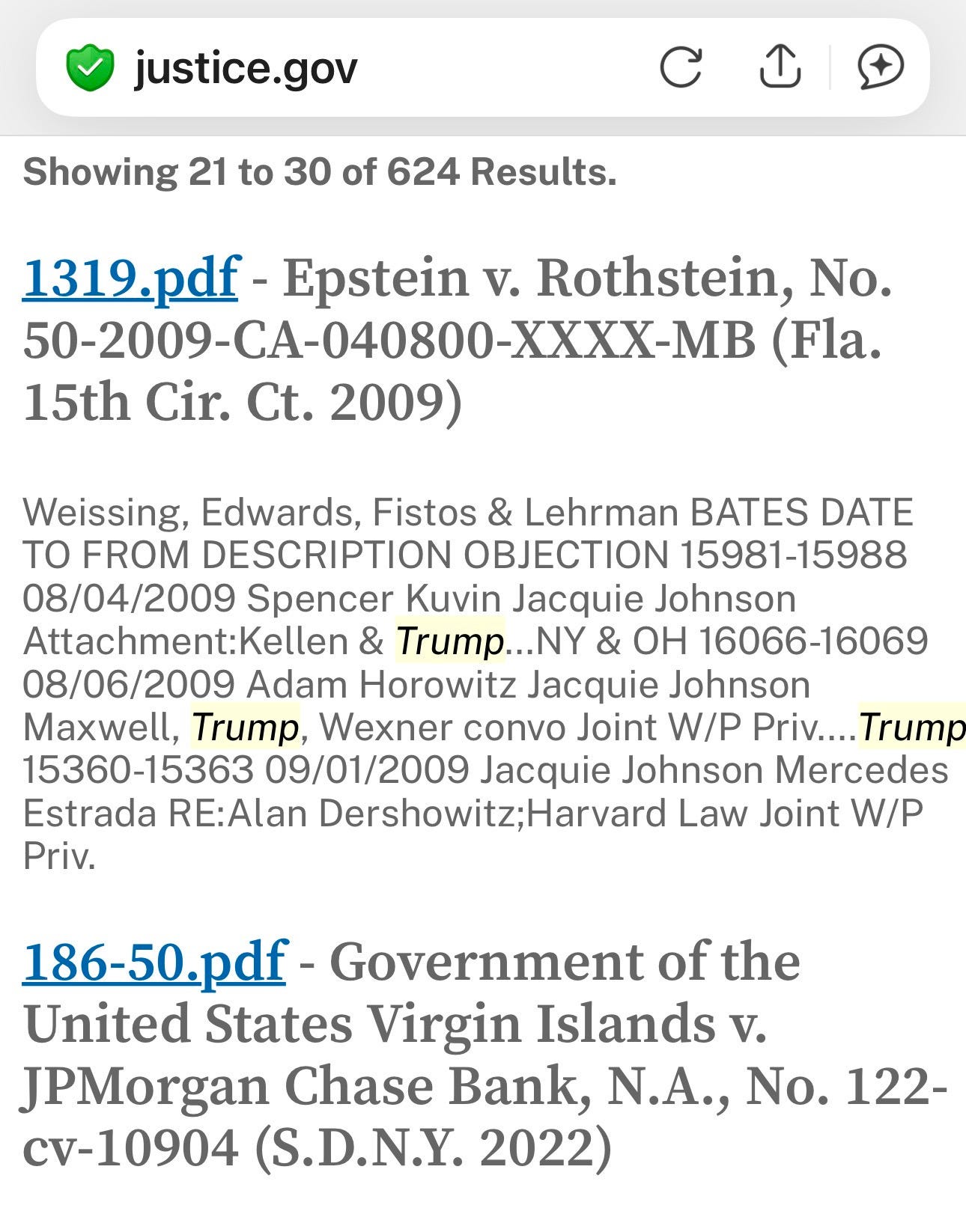
A search for “Trump” currently returns 624 documents. In countless PDFs, his name is blacked out. But in the database summaries, the metadata, the case descriptors —the skeletal framework holding the entire archive together — it remains, clear as day. The redaction was a performance applied to PDFs, not an integrity applied to the record itself. They blacked-out the windows but left signs on the doors.
You can see it for yourself in minutes. No insider access required. The machine, doing its job clumsily, tells a different story than the custodians intended. This isn’t conspiracy; it’s carelessness. And in matters of justice, carelessness that obscures powerful men is indistinguishable from complicity.
Not Tribal. Not Negotiable.
Before the chorus swells — yes, Clinton too.
This isn’t tribal. If Bill Clinton committed crimes with Epstein, he belongs in a cell. Period. Legacy is irrelevant. Nostalgia is a coward’s refuge. Accountability is not a toggle switch we flip based on political convenience.
So I searched Clinton as well. The results tell a story about documentary texture, not guilt. Many Clinton hits are buried in monolithic evidence dumps — gigantic PDFs labeled “DataSet,” sprawling inventories of photo files (“Fat East126.JPG,” “Far East127.JPG”) that feel like raw evidence haul, not curated testimony.
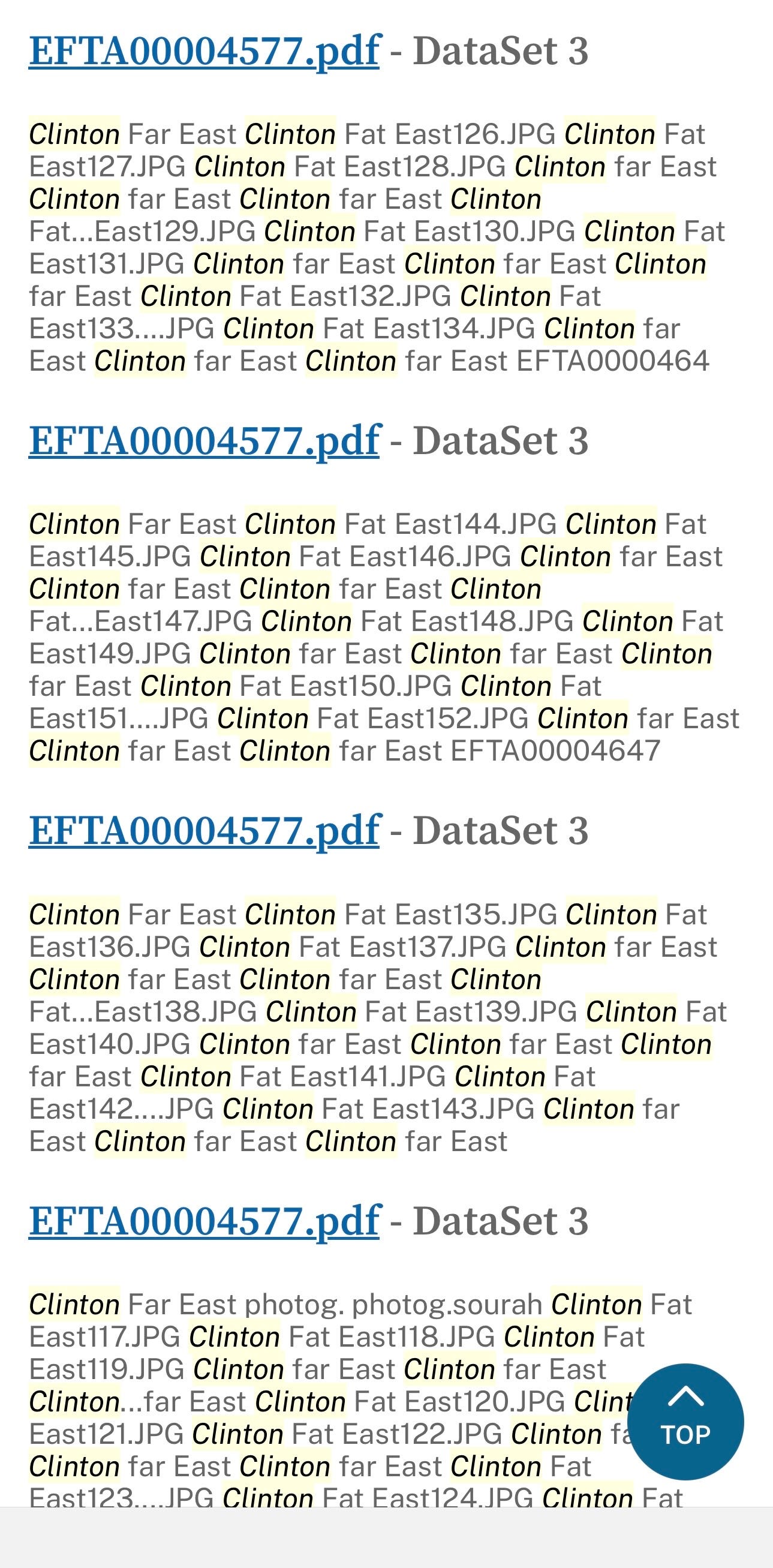
Trump’s name, by contrast, is woven into the legal narrative itself: call logs seized from Epstein’s mansion, objections filed by lawyers, descriptions of social visits, witness lists in Palm Beach lawsuits. His presence is in the connective tissue — the notes, the motions, the correspondence — even when the specific pages are now censored.
Counting names is for headlines. Tracing how they appear in the architecture of the case file is where the machinery of power reveals itself.
None of this establishes guilt. It should all be investigated, wherever it leads. But what I’m documenting here isn’t guilt; it’s the texture of impunity. It’s the difference between a system that seeks truth and one that manages records to protect the powerful.
Maxwell Then vs. Maxwell Now
Here, the record breathes, and you can feel the temperature change.
In 2015 depositions, under oath, the association is matter-of-fact: Trump was “a friend,” “a frequent visitor” to Epstein’s residence. The language is plain, unguarded, rooted in a time before certain political fortunes were set in stone. It’s a fossil preserved in legal amber.
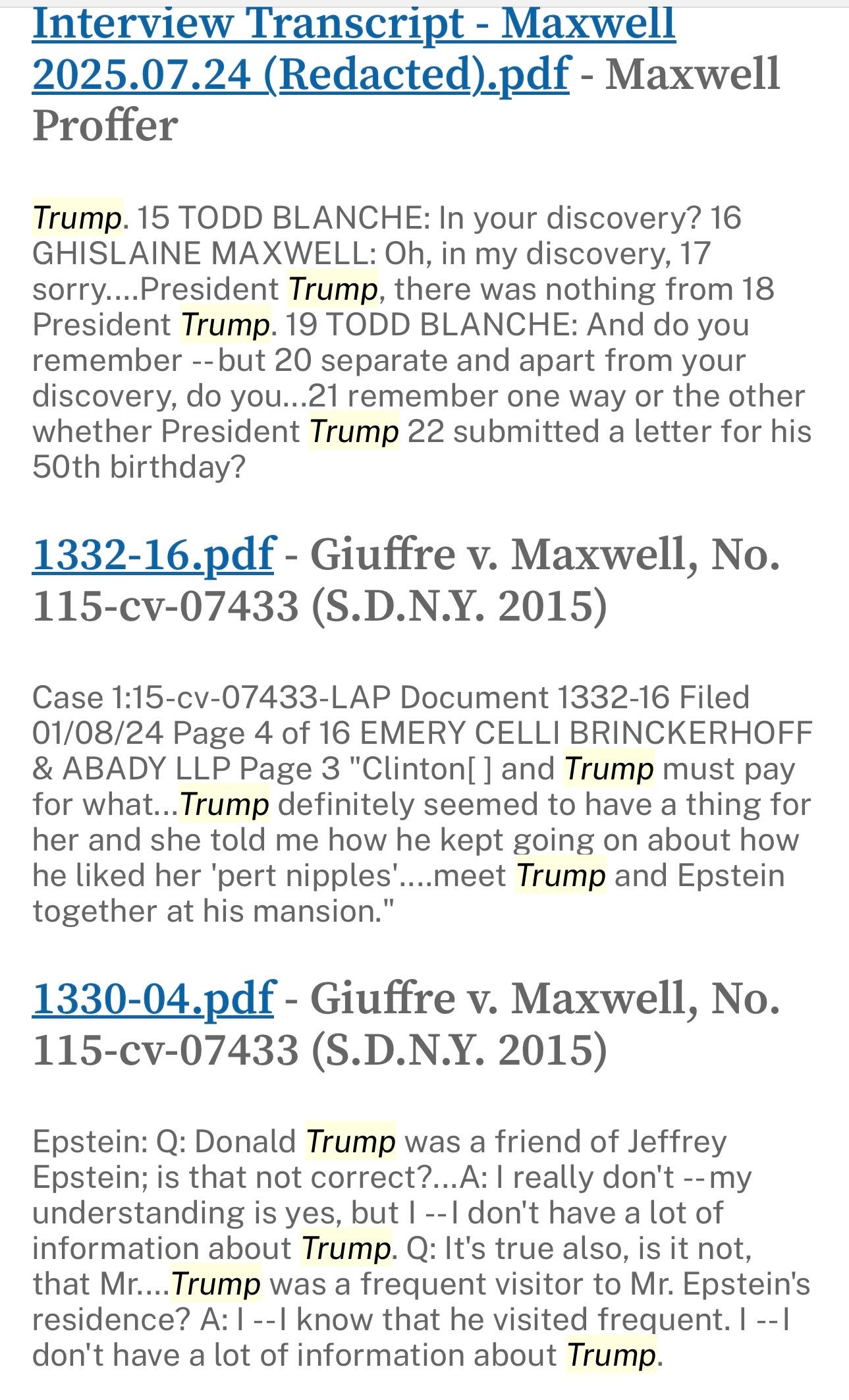
Fast forward to a 2025 interview with Maxwell. The tone tightens. Memory narrows. “In my discovery, sorry… there was nothing from President Trump.” The relationship, once openly acknowledged, is now cautiously contained. The framing has shifted with the political weather.
The DOJ’s redactions mirror this drift. Material aligning with the later, narrower story often remains visible. The earlier, blunter, and more inconvenient context is what vanishes into black ink — except where the database, an unthinking digital clerk, forgot to follow the new script.
This is narrative management through administrative process. Whether by design or dysfunction doesn’t change the outcome: powerful men get the benefit of institutional memory loss while the database remembers what humans decided to forget.
What the Redactions Obscure — Allegations in the Record
This is where the redactions stop being abstract.
Within the Epstein litigation record, sworn testimony and affidavits submitted under penalty of perjury include allegations, raised by named witnesses, that Donald Trump engaged in sexual contact with a minor. These allegations were never adjudicated and do not constitute findings of fact. But they are not rumor or speculation. They exist as part of the official court record, raised formally and preserved in filings that the public has a legal right to access.
That distinction matters. Transparency does not require a conviction. It requires disclosure. DOJ redactions do more than obscure names or context — they materially interfere with public access to the existence of these allegations themselves. Meanwhile, the database metadata continues to surface Trump’s name across case summaries and attachments, preserving what the redactions attempt to suppress.
What Was Left Behind
While the world screams about what’s hidden, the more damning story is what was left behind.
A search engine that hasn’t gotten the memo. Metadata that remembers what the redactors forgot. A system that, in its dry, digital way, mentions the quiet part because nobody bothered to tell it to stay silent.
You can’t redact a database by redacting PDFs. This isn’t a technical oversight — it’s a procedural failure that reveals the architecture of institutional cover. They built the opacity for human readers while leaving the machine-readable record intact.
The law required full disclosure and prohibited redactions based on political sensitivity. The law gave them 30 days. They violated it.
And then, in violating it, they did the job so sloppily that the system itself became the whistleblower.
What Happens Next
The Epstein Files Transparency Act has no enforcement mechanism. Congress is “examining options.” That’s institutional speak for “we’ll see.” The DOJ has calculated, correctly, that absent immediate consequences, they can violate federal law with a shrug and a promise to do better later.
This is how impunity operates in plain sight. Not through dramatic cover-ups, but through bureaucratic delay and the public’s exhaustion with complexity.
But here’s what they didn’t account for: you don’t need to be a lawyer or a hacker to expose this. You need a browser and five minutes. The evidence of their violation sits on their own servers, searchable and damning.
So search it. Document it. Archive it before they realize what they left exposed.
Because the database has a memory. And right now, by accident or incompetence, it’s telling the truth they broke the law to hide.
Always unfiltered, always fighting—Zorha.
Support is never expected but always appreciated. Subscriptions and Buy Me a Coffee help keep this work independent and accessible. All core reporting remains free — support simply helps me keep digging.
METHODOLOGY & VERIFICATION (updated 12/23/25)
All searches referenced in this analysis were conducted on the Department of Justice’s public Epstein records portal (justice.gov) on December 19, 2025. Search terms included “Trump” (624 results) and “Clinton” (1,066 results). Returned documents were reviewed for consistency between PDF-level redactions and the corresponding database metadata, including document titles, descriptions, case summaries, attachment listings, and portal-level indexing text.
Returned files were examined for redaction integrity, including whether redactions were properly flattened at the PDF level or applied as superficial visual overlays that left the underlying text layer intact. Files were also reviewed for metadata exposure where database descriptions or indexing text conflicted with or undermined visible redactions in the PDF.
References to allegations are drawn from sworn testimony and affidavits filed in Epstein-related civil litigation. These allegations have not been adjudicated and are not presented as findings of fact. They are included solely to document their existence in the court record and to assess how DOJ redactions affect public access to legally filed material.
Primary source materials include: Giuffre v. Maxwell, No. 1:15-cv-07433 (S.D.N.Y. 2015); Epstein-related civil proceedings in Palm Beach County, Florida (15th Judicial Circuit, 2009); Interview Transcript – Maxwell 2025.07.24 (Redacted); 2022.03.17-1 Exhibit 1; The Database Has a Memory; and the Epstein Files Transparency Act, Pub. L. 119-38 §2(a).
* Plain-English note on “flattened redactions” and metadata:
A properly redacted PDF is flattened, meaning the text underneath the black bars is permanently removed. You can’t select it, copy it, or quote it because it’s gone.
In several DOJ Epstein files, the redactions were only visual overlays. The text underneath remained in the document and was readable.
Metadata is the background information attached to a file—titles, tags, descriptions, attachment names, and indexing text in the DOJ database. In multiple cases, that metadata remained visible and contradicted what the black bars appeared to conceal.
In short: the screenshot shows what DOJ wanted readers to see. The quoted text shows what was actually still there.
This is freaking crazy. I feel like we need to be quiet about this until the rest of the files are released and the database is wiped clean. Can that happen?
This 'transparency' legislation, if I understand correctly, was voted on by a near-unanimous bipartisan majority. The way the law is written makes me wonder if there were some people, likely Republicans, who had this law written in such a way as to prevent full disclosure. Who specifically had input into drafting this legislation?
Obviously the DOJ made a mockery of this so-called release, as they may claim that certain investigations are ongoing. But one thing is clear, there are some villains involved in this case. The DOJ can claim that they are trying to 'protect' the victims all they want.
So what happened to the 'protection' for Virginia Giuffre? That looks like a failure on part of the DOJ.
The Department should put an emphasis on protecting the victims, yes, but not at the expense of letting the villains get off the hook, especially if one of them is the current resident of 1600 Pennsylvania Avenue.